
BOP Releases Linked to Erath
The Federal Bureau of Prisons is the federal sentenced-custody system. It is separate from Erath County Jail, TDCJ, ICE, and U.S. Marshals Service pretrial custody. A person may leave an Erath County booking through a federal transfer, but that county exit is not a BOP release. Federal prison custody must first begin, and a later BOP record must show how that federal episode ended.
No federal BOP institution was verified within Erath County. The correct search is national. The official BOP Inmate Locator covers federal inmates from 1982 forward. It can directly return a past release date and a status such as Released or Not in BOP Custody. Those labels answer a precise question: whether BOP still holds the person.
How to Search BOP Releases
Use an identifier when available. BOP accepts a BOP register number, DCDC number, FBI number, or INS number. Its name search permits an exact name with optional age, race, and sex filters. Compare the returned identifiers and personal descriptors before treating a result as the intended person.
- Open the official BOP Inmate Locator.
- Select the identifier search when a register, DCDC, FBI, or INS number is known.
- Otherwise enter the name and use optional filters only to narrow a likely match.
- Compare the register number, age, race, sex, and name for identity.
- Read the release date and location or status together.
- Check the federal docket and any other known custodian before calling the result community release.
A no-result can reflect pre-1982 custody, spelling, identifiers, a person never committed to BOP, or another federal custodian. It does not prove that the person was never detained federally.
BOP Release Locator Fields
The locator’s compact result needs context. A release date is stronger than a future date, but the status still belongs only to BOP. Location can identify a current federal institution or display a status instead. Use the register number to keep one person’s federal record separate from another person with the same name.
| Field | What it shows |
|---|---|
| Name | The name attached to the federal locator record |
| Register number | The strongest public BOP record identifier |
| Age, race, sex | Descriptors that help check a possible match |
| Release date | Past or projected BOP custody date, interpreted with status |
| Location or status | Current institution or a result such as Released or Not in BOP Custody |
The captured official BOP locator shows the federal search interface used for these fields.
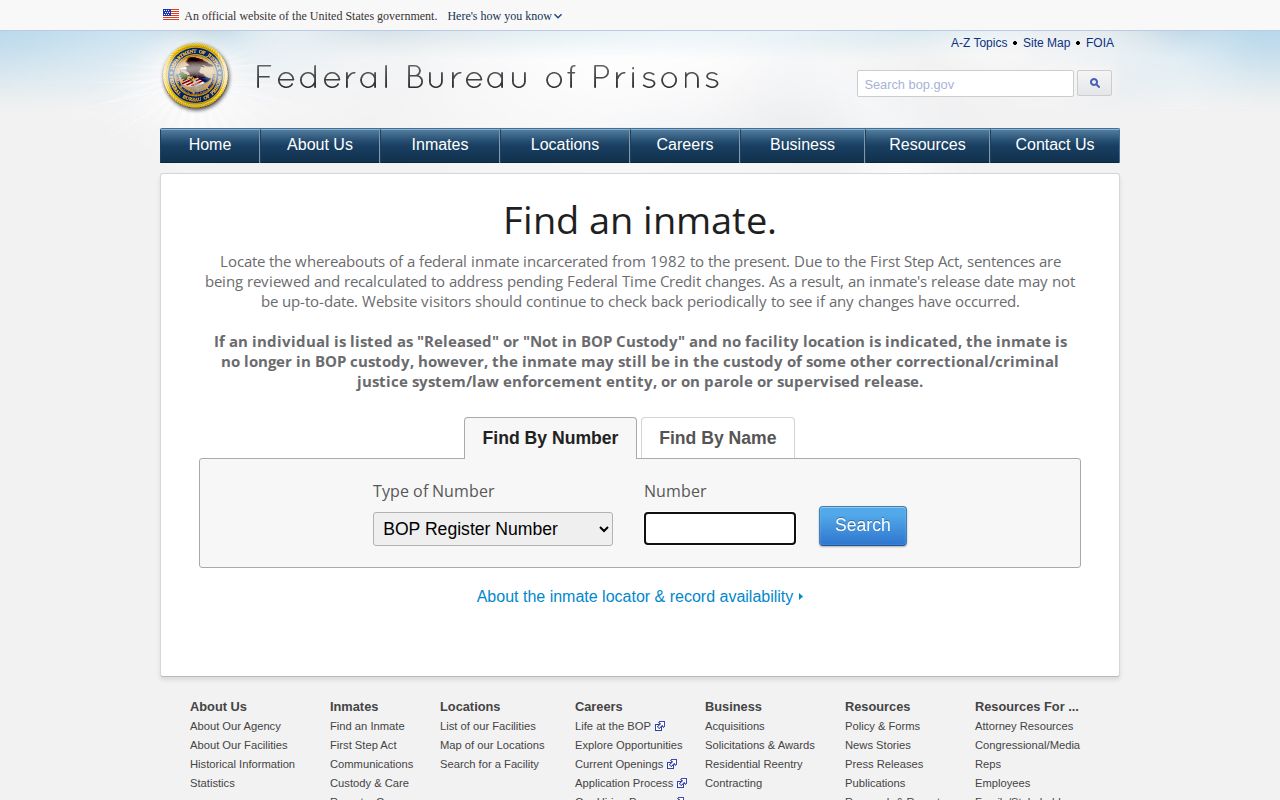
The interface supports sentenced-federal release verification, not a county jail or USMS release search.
Read BOP Release Status Carefully
“Released” indicates that the covered BOP episode ended. “Not in BOP Custody” likewise states that BOP does not currently hold the person. Neither phrase says where the person went. A state warrant, ICE detainer, local case, or another correctional authority may continue custody after BOP relinquishes control.
Federal supervised release is also distinct from incarceration. A person can leave BOP and remain subject to court-ordered supervision. The federal judgment and docket show the imposed supervision term and later court action. BOP’s locator is not designed to display every condition or prove that all federal legal obligations ended.
- BOP custody
- Sentenced federal incarceration administered by the Bureau of Prisons.
- Supervised release
- A federal court-ordered period after incarceration, separate from BOP confinement.
- Detainer
- Another authority’s request or hold that can lead to continued custody.
- Community release
- A conclusion that requires checking other custodians, not just the BOP status.
BOP Future Release Dates Change
BOP warns that future release dates can change. Sentence computation and First Step Act credit calculations may be revised as records and earned credits change. A displayed future date should therefore be described as projected, not promised. Check the locator again near the date and look for the eventual past release date and updated status.
A federal court order can also affect the controlling sentence. The docket may show an amended judgment, sentence reduction, or another order. A detainer can change the next custodian even when the BOP date itself arrives. Keep the predicted BOP exit, the actual status update, and the destination as separate questions.
Note: A future BOP date is a calculation and should never be restated as proof that federal custody already ended.
Federal Docket Release Proof
The federal docket supplies legal context that the locator does not. Read the judgment for the prison term and supervised-release term. Later entries may address sentence changes, release conditions, revocation, or a new detention matter. A docket order and the BOP locator can corroborate one another while answering different parts of the timeline.
If the person was only in federal pretrial or transport custody, BOP may have no record because the U.S. Marshals Service often uses local or contract detention. In that case, identify the actual detention facility and use the federal docket for detention, bond, dismissal, release, or remand orders. The USMS custody page covers that separate route.
A signed order can precede actual movement. Confirm that the custodial agency processed the order and check for state or immigration holds before stating the person physically entered the community.
BOP and Erath Custody Chains
An Erath-linked federal chain can contain several custodians. Local officers may arrest or book the person. USMS may assume federal pretrial responsibility and place the person in a contract bed. After a federal sentence, BOP may receive the person. At the end of BOP custody, another hold may control the next movement. Each handoff creates a separate record.
| Stage | Best record |
|---|---|
| Erath County booking | Sheriff booking and release or transfer transaction |
| Federal pretrial detention | Actual facility status and federal docket |
| Federal sentence | Judgment and BOP intake record |
| BOP release | BOP locator release date and status |
| Post-prison supervision | Federal judgment, supervision, and later docket orders |
| Another hold | Receiving agency’s custody record |
This sequence prevents an Erath transfer date from being confused with a later BOP release date.
About Federal BOP Facilities
BOP facilities are federal institutions for sentenced prisoners. They are not county jails, TDCJ prisons, ICE civil detention sites, or USMS contract beds as such. The national locator is appropriate because no BOP institution was verified in Erath County. Do not invent a local federal prison address, release door, telephone number, or release schedule.
The locator’s 1982-forward scope is a real limit. Older federal custody may require archival or court research. Even within its coverage period, name-only searching can miss spelling variants or attach a result to the wrong person. Identifiers and the federal case number provide the safest link across systems.
For a released result, preserve the register number, displayed release date, and status. Then review the federal judgment and check any known state, local, or immigration custody. That combination supports an accurate statement about the federal episode without overstating what BOP proves.