
How Erath County Parole and Probation Differ
Parole is a discretionary release from a TDCJ institution that lets a person serve the remaining part of a prison sentence in the community. The Texas Board of Pardons and Paroles makes the release decision. TDCJ Parole Division processes the release and supervises the releasee. Mandatory supervision is a separate TDCJ release form governed by statute and, for many later-law cases, Board review. Neither status means the sentence is complete.
Probation, called community supervision in Texas law and court records, is imposed by a judge. Erath County Community Supervision and Corrections Department administers adult probation locally. A person can receive probation without entering TDCJ custody, or can begin a probation term after a short county-jail term. The judgment, probation order, revocation order, and discharge order are the key documents.
| Question | Parole or mandatory supervision | Probation |
|---|---|---|
| Who imposes it? | Texas parole authorities act under the prison sentence | An Erath County court acts through its judgment or order |
| Who supervises it? | TDCJ Parole Division | Erath County CSCD |
| Erath-area office | Mineral Wells District Parole Office | CSCD in Stephenville |
| Best status proof | TDCJ status, release history, and parole records | Court judgment and community-supervision orders |
| Does it prove jail release time? | No | No |
How to Verify Erath County Post-Release Supervision
Start with the custody chain, not with a broad name search. The Erath County released-inmate search and records guide explains how to identify the custodian that ended its custody. Then apply the matching supervision route.
- Find the jail release transaction, TDCJ record, or court judgment that identifies the release authority.
- If TDCJ is involved, search by the SID or current TDCJ number before trying an exact name.
- Open the TDCJ detail and read Offender Status, Facility, Expected Release Date, actual Release Date, and intake or release history together.
- For parole or mandatory supervision, use the Mineral Wells District Parole Office for an appropriate public confirmation question.
- For court-ordered probation, search the Erath Tyler Odyssey court portal and identify the judgment, probation order, revocation, or discharge entry.
- Contact Erath County CSCD only after the court record indicates local community supervision.
Reading TDCJ Release and Parole Status
TDCJ offers an official inmate-information page, a legacy inmate search, and its newer IVSS public interface. The strongest public release indication combines an actual Release Date with an Offender Status that fits parole, mandatory supervision, or discharge. A blank facility field or a missing search result is not enough. An Expected Release Date is a forecast, while a Release Date is a recorded event in the TDCJ custody system.
Search by SID or TDCJ number when possible because names can be shared or entered in more than one form. Compare county, offense, and intake history if the interface shows them. A transfer from Erath County Jail to TDCJ ends the county custody episode, but it is still incarceration. Only a later TDCJ release record can support a prison-release conclusion.
TDCJ also accepts inmate-information inquiries by email at its official inmate information channel. The research instructions list full name and seven-digit TDCJ number as the preferred identifiers. When the number is unknown, exact date of birth or approximate age and county of conviction can help. Published locator numbers are 936-295-6371 and 800-535-0283.
Erath County Parole Review Is Not a Hearing Calendar
Texas does not conduct an ordinary formal hearing for routine parole or mandatory-release consideration. A three-member panel reviews files and votes in sequence. Two matching votes finalize a result. TDCJ identifies cases before review, and an institutional parole officer prepares a case summary. A person-specific status route is therefore more useful than looking for a public calendar.
Board vote codes contain details that the words approved or denied omit. An approval may carry a future date, a program condition, a transfer condition, or another requirement. A denial can set the next review date or direct that a person serve a balance. New information can also cause an approval to be withdrawn. Call 844-512-0461 for the published parole review line. After a favorable vote, release processing questions use 512-406-5202. Neither call should be replaced by a guess based on eligibility.
Erath County Parole Office Contact
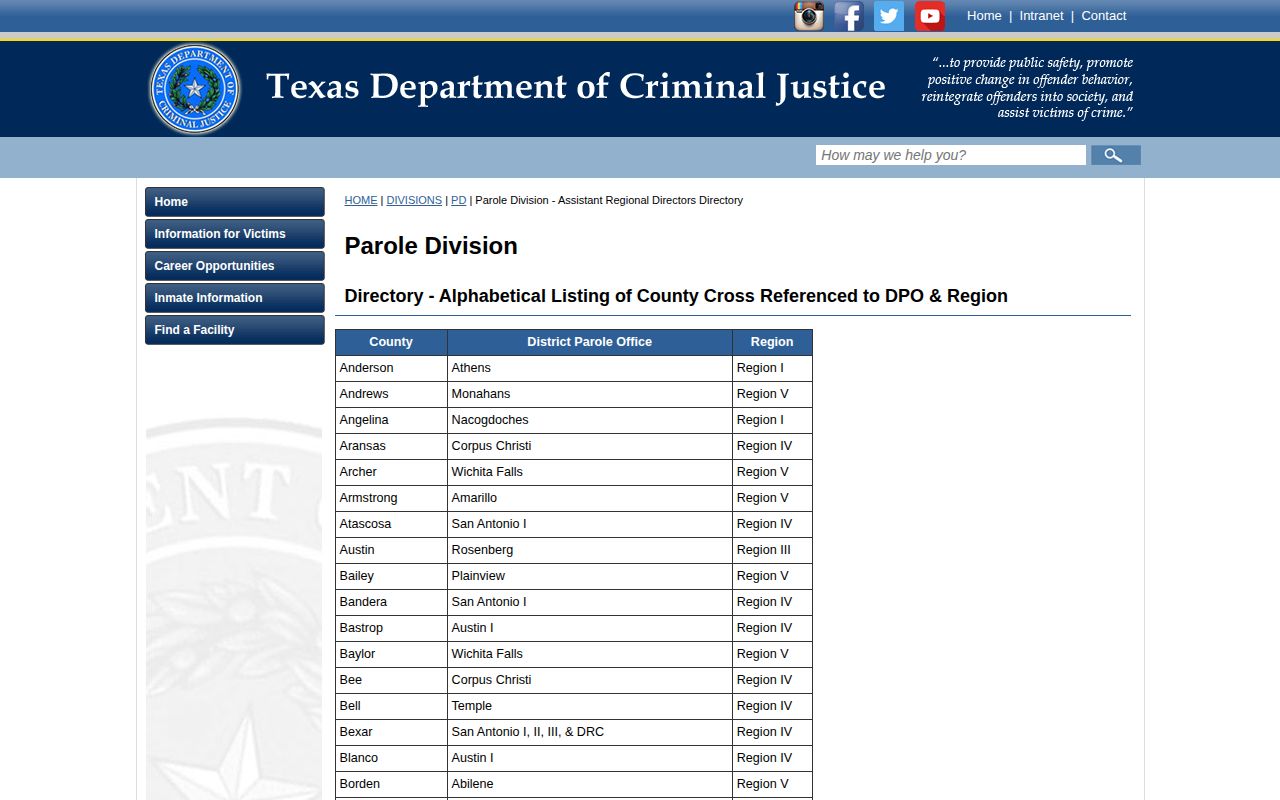
TDCJ assigns Erath County parole and mandatory-supervision cases to an office outside the county. The official county assignment directory and Region II directory identify Mineral Wells. This is a state supervision office, not a jail, court clerk, or county probation department.
Mineral Wells District Parole Office
Address: 999 Cross Post Road, Mineral Wells, TX 76068
Phone: 940-325-7811
Fax: 940-325-9732
Role: TDCJ parole and mandatory-supervision field office for Erath County assignments.
Public confirmation remains subject to confidentiality and the limits of what staff can release. Give a TDCJ number or SID when available, and ask a narrow status question. The office cannot certify the exact time Erath County Jail released someone and does not administer ordinary Erath County probation.
The TDCJ county assignment directory documents the Erath-to-Mineral Wells route. The image below preserves that routing context.
Erath County Probation Records and CSCD
The Erath County CSCD office is in Room 102 of the Donald R. Jones Justice Center, 298 South Graham Street in Stephenville. Its published telephone number is 254-965-1487. County hours are listed as Monday through Friday, 8:00 a.m. to noon and 1:00 p.m. to 5:00 p.m. This office handles adult community supervision imposed by an Erath court.
Begin with the unified County Clerk and District Clerk Tyler Odyssey portal. Smart Search can expose the case number, court, charge, docket events, disposition, judgment, probation order, revocation, and discharge entries when those items are public and online. The court record establishes what the judge ordered. It does not ordinarily certify the moment jail staff completed release unless a filed return or release document contains that fact.
Supervision terms
Parole: discretionary TDCJ release with the sentence continuing under supervision. Mandatory supervision: a separate statutory TDCJ release form. Probation: court-imposed community supervision handled locally. Discharge: completion of the relevant sentence or supervision.
Erath County Absconder and Warrant Limits
TDCJ calls a releasee an absconder when the person has stopped reporting and the person's location is unknown. Its Parole Division Warrants Section takes anonymous tips around the clock at 866-680-6667. A parole warrant may arise from an alleged new act, failure to report, or an administrative violation. A warrant is not proof of a new conviction.
The public TDCJ absconder site has a narrow scope. It is specifically a Sex Offender Absconder Information Search, not a complete public list of all parole absconders or all supervision warrants. A no-result cannot clear a person. A listed result must also be read as an active supervision matter, not as proof of the underlying allegation. For immediate safety concerns, contact the proper public authority rather than trying to resolve a status from web results alone.
Why Erath County Uses Two Supervision Offices
Erath County has a distinctive legal and geographic split. Local probation sits in Stephenville, but TDCJ maps parole cases to Mineral Wells. Calling the closer office is not the rule. The judgment and TDCJ status determine which agency has authority.
A person released on bond may have court conditions while the criminal case continues, yet have neither probation nor parole. Someone transferred to TDCJ remains in custody and is not ready for either community office. A TDCJ releasee may live under parole or mandatory supervision even though the original case arose in Erath County. A fully discharged person may have no active supervising office at all. Sorting these stages first prevents an office from appearing unhelpful when it simply lacks jurisdiction.
Public Record Search
Sponsored Results